Description
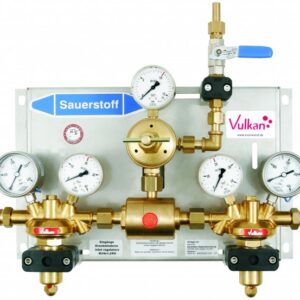
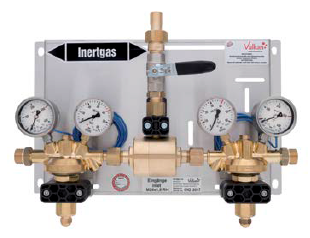
The VULKAN AM 40/300 Effect is the performance step above compact low-pressure manifold stations. It is intended for users who need higher outlet pressure and more throughput without giving up automatic continuity. The catalog specifies 300 bar inlet pressure, fixed 28 bar outlet pressure, up to 120 Nm³/h flow, brass body construction and PTFE diaphragm execution, with stainless-steel diaphragm specification for oxygen service.
Unlike semi-automatic systems, which still leave part of the switching cycle dependent on operator action, the Modula automatic manifold platform is designed to switch from the depleted side to the full side automatically. That reduces intervention points, lowers the risk of timing errors during cylinder replacement and supports more stable process continuity in real production.
That makes the AM 40/300 Effect relevant for pressure reduction stations, central gas supply lines, laser support gas networks, oxygen service and other industrial process systems where a pressure drop during changeover is not acceptable. It bridges the gap between compact manifold hardware and heavier central distribution assemblies.
Key Advantages
- 28 bar outlet class supports higher-pressure downstream systems.
- Automatic pneumatic switching reduces avoidable process interruption.
- High-capacity design handles up to 120 Nm³/h at 28 bar.
- Stainless-steel diaphragm specification for oxygen service strengthens technical positioning.
- Suitable base for modular plant layouts and pressure reduction stations.
Food-Gas / Compliance Positioning
This manifold can be positioned for food-gas projects when it is ordered with the appropriate wetted materials, elastomers, cleanliness level and documentation package. Regulation (EC) No 1935/2004 defines the basic requirement that materials in contact with food must not transfer substances in quantities that could endanger health or unacceptably change the composition or organoleptic properties of food. Regulation (EC) No 2023/2006 adds GMP requirements for controlled manufacturing processes. In Germany, LFGB is part of the legal framework used for control of food-contact materials and articles.
Table 1. Technical Data
| Parameter | Value |
| Body | Brass |
| Seals | EPDM, polyamide, Viton, PTFE |
| Diaphragm | PTFE; O2: stainless steel |
| Leakage rate | 1 × 10⁻⁶ mbar l/s |
| Temperature | -20 to +60 °C |
| Max. inlet pressure (pe max) | 300 bar |
| Outlet pressure (pa) | 28 bar |
| Max. flow (Qmax) | 120 Nm³/h at 28 bar |
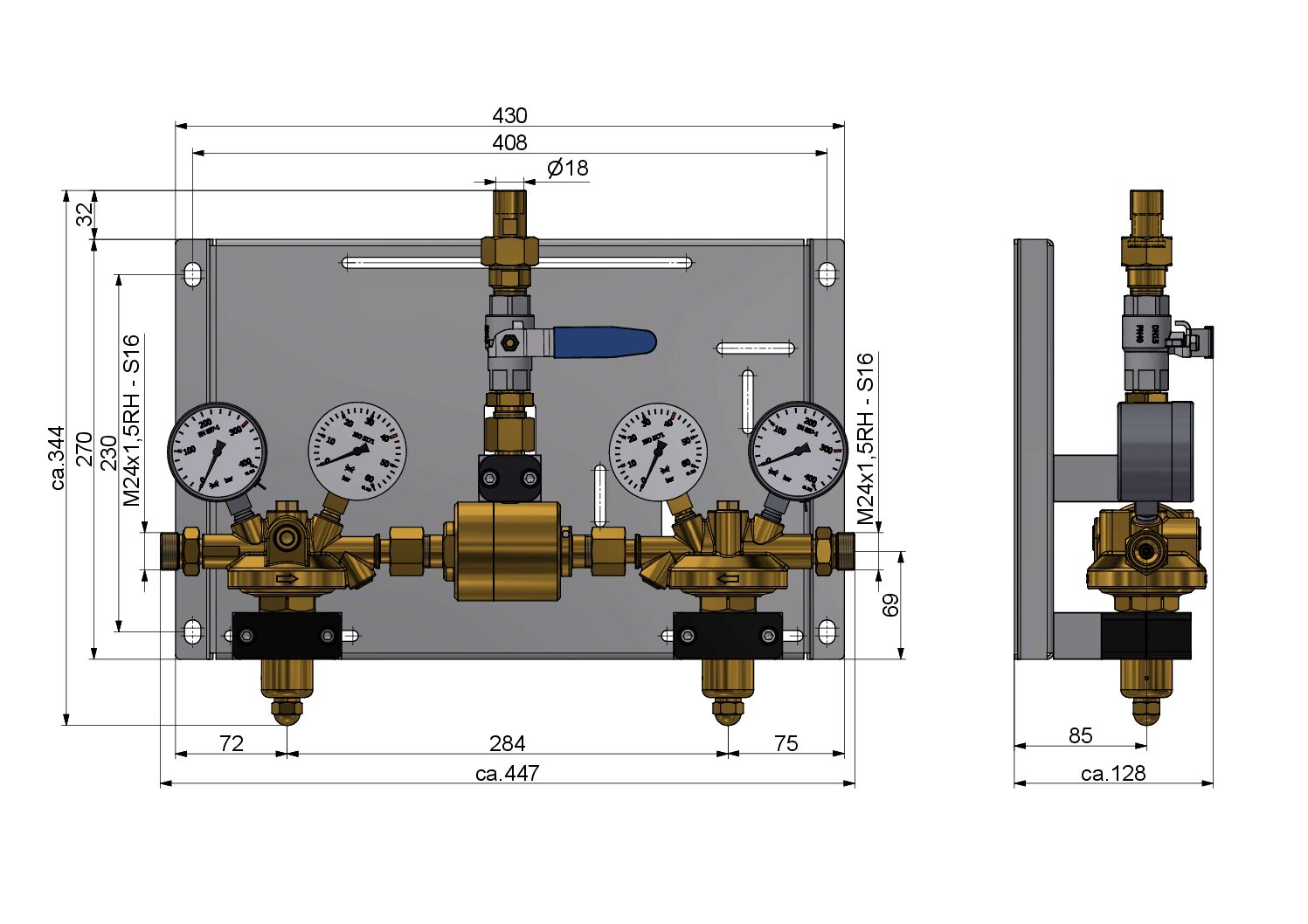
| Inlet connection (de) | M 24 × 1.5 RH |
| Outlet connection (da) | G 3/4 × 18 mm |
| Width (B) | 530 mm |
| Height (H) | 400 mm |
| Depth (T) | 210 mm |
| Weight (M) | 9.5 kg |
Table 2. Versions and Article Numbers
| Gas type | With contact gauge | Without contact gauge |
| Oxygen (to 30 bar) | 414 841 | 413 842 |
| Nitrogen | 414 341 | 413 342 |
| Argon | 414 641 | 413 642 |
| CO₂ | 414 641 06 | 413 652 06 |
| Helium | 414 641 26 | 413 652 26 |
| Hydrogen | 414 441 | 413 442 |
| Compressed air | 414 741 | 413 742 |